

Project Description
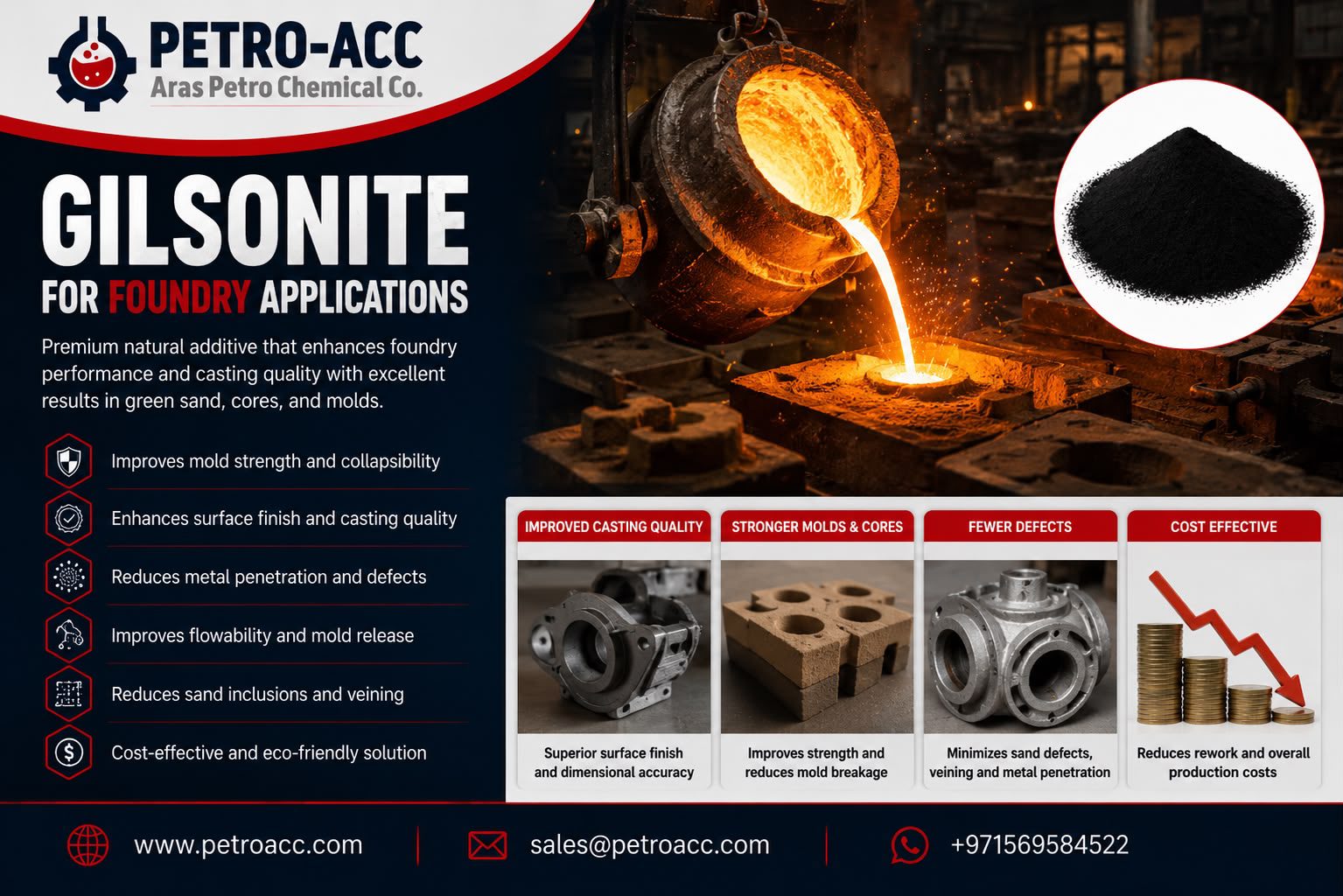
Aras Petrochemical supplies premium Gilsonite powder for the foundry industry, delivering excellent casting surface finish, reduced burn on, and improved mold performance. Our high purity Gilsonite enhances casting quality, minimizes production defects, and increases operational efficiency, making it an ideal carbon additive for gray iron, ductile iron, and steel foundries worldwide.
In these days, Gilsonite is widely used in the foundry casting industry. Gilsonite because of its special bonding properties can also be used in this industry too and you can buy from PETRO-ACC this grade of Gilsonite for foundry applications with long experience of supplying it to clients.
| Name | Gilsonite for Foundry |
| Manufacturer | PETRO-ACC |
| Made By | Aras Petrochemical Company |
| Product Code | ACC943 |
GILSONITE FOR FOUNDRY INDUSTRY
Gilsonite is a natural hydrocarbon resin widely used in the foundry industry to improve the quality and efficiency of metal casting operations. Due to its unique chemical composition, high fixed carbon content, and excellent thermal properties, Gilsonite serves as an effective additive in green sand systems, core sand, facing sand, and molding compounds. Aras Petrochemical manufactures high purity Gilsonite powder with controlled particle size and low ash content, making it an ideal solution for modern foundries seeking superior casting performance.
When incorporated into foundry sand mixtures, Gilsonite decomposes under high casting temperatures and generates a protective reducing atmosphere around the molten metal. This action minimizes oxidation, prevents metal penetration into the sand mold, and significantly reduces casting defects such as burn-on, veining, scabbing, and sand fusion. The result is smoother casting surfaces, improved dimensional accuracy, and reduced cleaning and finishing operations after casting.
Gilsonite also enhances the collapsibility and strength of molds and cores. It improves the flowability of molding sand, allowing molds to fill more uniformly while maintaining excellent structural integrity during pouring. At the same time, it facilitates easier shakeout after solidification, increasing production efficiency and reducing labor costs.
Another important advantage is its ability to improve the surface finish of cast iron, ductile iron, and steel components. Foundries using Gilsonite often experience fewer rejected castings, lower scrap rates, and higher productivity due to the consistent quality of finished products. Its natural lubricating characteristics also contribute to improved mold release and reduced wear on molding equipment.
From an economic perspective, Gilsonite is a highly cost effective additive. Because of its excellent performance, smaller dosages are often sufficient to achieve outstanding results, helping reduce the consumption of other carbonaceous additives and lowering overall production costs.
Aras Petrochemical supplies premium Gilsonite powder suitable for a wide range of foundry applications. With consistent quality, controlled specifications, reliable supply, and excellent technical performance, our Gilsonite helps foundries produce cleaner castings, improve operational efficiency, minimize defects, and achieve superior metal casting quality across a variety of ferrous and non ferrous casting processes.
FEATURES OF USING GILSONITE FOR FOUNDRY
Gilsonite has become an essential additive in the foundry industry due to its excellent carbon content, thermal stability, and mold-enhancing properties. It is widely used in green sand molding, core sand, and facing sand to improve casting quality, reduce defects, and increase production efficiency. Its unique physical and chemical characteristics make it one of the most reliable carbonaceous additives for producing high quality ferrous and non-ferrous castings.
One of Gilsonite’s most valuable features is its ability to create a reducing atmosphere during metal pouring. This minimizes oxidation at the mold metal interface, producing cleaner castings with smoother surfaces and fewer finishing operations. It also effectively prevents metal penetration into the sand mold, reducing defects such as burn on, sand fusion, veining, and scabbing.
Gilsonite improves the flowability and bonding of molding sand, allowing molds and cores to maintain excellent strength while remaining easy to break down after casting. Its high volatile matter creates a protective carbon film that enhances mold release and improves the surface finish of cast components.
Another important feature is its high thermal stability, enabling consistent performance under the extreme temperatures encountered in iron and steel foundries. It is compatible with conventional foundry binders and can be incorporated into existing molding processes without requiring significant operational changes.
Main Features
- High fixed carbon content
- Excellent thermal stability
- Produces a protective reducing atmosphere
- Prevents metal penetration into sand molds
- Reduces burn-on, scabbing, veining, and sand fusion
- Improves mold and core performance
- Enhances casting surface finish
- Improves mold collapsibility after casting
- Increases dimensional accuracy
- Compatible with green sand and resin-bonded systems
- Low ash content for cleaner castings
- Easy to blend with foundry sand mixtures
- Consistent quality and particle size
- Reduces cleaning, grinding, and finishing costs
- Improves production efficiency and casting yield
Gilsonite is a proven foundry additive that helps manufacturers produce higher quality castings with fewer defects, lower production costs, and improved operational efficiency, making it an ideal solution for modern metal casting applications.
ADVANTAGE OF USING GILSONITE IN FOUNDRY
Gilsonite has numerous advantages in foundry applications. It is widely used as a carbonaceous additive in green sand molding, facing sand, and core sand systems to improve casting quality, increase production efficiency, and reduce manufacturing costs. Its unique thermal behavior and high fixed carbon content make it an excellent alternative or supplement to traditional carbon additives.
One of the greatest advantages of Gilsonite is its ability to produce a protective reducing atmosphere during the metal pouring process. This minimizes oxidation at the mold-metal interface and significantly reduces casting defects such as burn-on, sand fusion, veining, scabbing, and metal penetration. As a result, castings have smoother surfaces and require less grinding, machining, and cleaning after production.
Gilsonite also improves the flowability and strength of molding sand, enabling molds and cores to maintain excellent dimensional stability during casting while remaining easy to break down after solidification. This improves shakeout efficiency and shortens production cycles.
Another important benefit is its ability to enhance casting surface finish. The carbon-rich gases released during pouring create a protective carbon film between the molten metal and the mold, resulting in cleaner castings with greater dimensional accuracy and fewer rejected parts.
From an economic standpoint, Gilsonite helps reduce production costs by lowering scrap rates, minimizing finishing operations, decreasing tool wear, and improving casting yield. Its low ash content and consistent quality ensure reliable performance from batch to batch, while its compatibility with conventional foundry binders allows easy integration into existing molding systems.
Main Advantages
- Produces smoother casting surfaces
- Reduces burn-on and metal penetration
- Minimizes scabbing, veining, and sand fusion
- Improves mold strength and collapsibility
- Enhances dimensional accuracy
- Reduces cleaning and finishing costs
- Lowers scrap and rejection rates
- Improves shakeout efficiency
- Compatible with green sand and resin-bonded molds
- High thermal stability and low ash content
- Reduces consumption of other carbon additives
- Increases overall foundry productivity
By improving casting quality, reducing production defects, and lowering manufacturing costs, Gilsonite has become one of the most effective and economical additives for modern foundry operations, helping manufacturers achieve higher productivity, better product quality, and greater profitability.
Some more advantages of using Gilsonite in the foundry industry would be such as:
- Gilsonite produces gas three times more than sea coal, which allows the product to separate better from the mold
- Gilsonite due to its high percentage of carbon makes the product pay better after leaving the mold
- Reduces the space between the mold and the material and makes the product more productive
GILSONITE IS USED IN TYPES OF FOUNDRIES
Gilsonite is widely used in both ferrous and non ferrous foundries as a premium carbonaceous additive for molding and core sand systems. Its excellent thermal stability, high fixed carbon content, and low ash make it suitable for producing high-quality castings with improved surface finish and fewer casting defects.
Types of Foundries That Use Gilsonite
1. Gray Iron Foundries
Gilsonite is extensively used in gray iron casting to improve surface finish, reduce burn-on, and prevent metal penetration into the sand mold.
2. Ductile Iron (Nodular Iron) Foundries
It enhances mold performance and produces cleaner, smoother ductile iron castings with improved dimensional accuracy.
3. Steel Foundries
Steel foundries use Gilsonite because of its excellent thermal stability and ability to withstand the high pouring temperatures of carbon steel, alloy steel, and stainless steel castings.
4. Foundries Producing Cast Iron Components
Ideal for manufacturing:
- Engine blocks
- Brake drums
- Pump housings
- Pipe fittings
- Valves
- Machine bases
5. Automotive Foundries
Used in the production of automotive engine parts, transmission housings, brake components, and suspension parts where superior casting quality is essential.
6. Heavy Machinery Foundries
Applied in the manufacture of mining equipment, agricultural machinery, construction equipment, and industrial machine components.
7. Municipal and Infrastructure Casting Foundries
Used for producing:
- Manhole covers
- Drainage grates
- Water pipe fittings
- Fire hydrant components
- Utility castings
8. Resin-Bonded Sand Foundries
Compatible with resin-bonded molding systems to improve mold performance and casting quality.
9. Green Sand Foundries
One of the most common applications, where Gilsonite improves mold strength, surface finish, and shakeout characteristics.
Gilsonite Benefits Across All Foundry Types
- Produces smoother casting surfaces
- Reduces burn-on, scabbing, veining, and sand fusion
- Prevents metal penetration
- Improves mold strength and collapsibility
- Increases casting yield
- Reduces scrap and rejection rates
- Minimizes cleaning and machining costs
- Improves dimensional accuracy
- Compatible with green sand and resin-bonded molding systems
- Cost effective replacement or supplement for traditional carbon additives
Aras Petrochemical manufactures high purity Gilsonite powder specifically processed for foundry applications. With its consistent quality, controlled particle size, and low ash content, our Gilsonite is trusted by gray iron, ductile iron, steel, automotive, heavy machinery, municipal casting, green sand, and resin bonded foundries to produce cleaner, stronger, and highe quality metal castings.
GILSONITE FOR FOUNDRY SPECIFICATION
| SPECIFICATION | TEST METHOD | A.S.T.M. |
| Ash content | 8-10% | D3174-4 |
| Flash Point | 316 C° | D92 |
| Volatile Combustible Matter | 81% | |
| Hydrogen Content | 10% | Elemental Analyzer |
| Sulfur Content | 0.3% | Elemental Analyzer |
| Carbon | 85 | Elemental Analyzer |
| Moisture Content | 0.5% | D3174 |
| Penetration | 0 | D5 |
| Specific gravity @ 25 C° | 1.05 | D3289 |
| Softening Point
Fixed Carbon Lustrous Carbon Content Coking Value Oxygen Silicon, Nickel & |
160-182 C°
18% 35-38% 25-30% 1.5% 0.3% |
E28-92 |