

Project Description
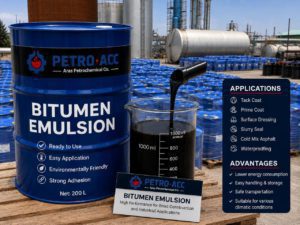
Bitumen emulsion is one of the main products of Aras Petrochemical Company that is producing in different grades for many applications such as road construction, asphalt maintenance, tack coat, prime coat, surface dressing, and waterproofing applications.
Bitumen emulsion is a liquid mixture made by dispersing bitumen in water with the help of emulsifying agents. It allows asphalt applications at lower temperatures without heating pure bitumen directly.
| Name | Bitumen Emulsion |
| Manufacturer | PETRO-ACC |
| Made In | Aras Petrochemical Company |
| Product Grade | Anionic & Cationic |
BITUMEN EMULSION FEATURES
Main Features of Bitumen Emulsion
- Excellent adhesion to aggregates and road surfaces
- Ready-to-use liquid form
- Easy spraying and application
- Lower heating requirements compared to hot bitumen
- Energy-saving and cost-effective
- Environmentally friendlier application process
- Fast setting and curing performance
- Suitable for cold and wet weather conditions
- Good waterproofing properties
- Reduced fire and handling risks
- Strong durability for road maintenance projects
- Compatible with surface dressing, tack coat, and prime coat applications
- Easy transportation and storage in drums, IBCs, or bulk tankers
BITUMEN EMULSION APPLICATIONS
Main Applications of Emulsion Bitumen are as below:
Road Construction
- Asphalt road paving
- Highway construction
- Rural and urban road projects
Road Maintenance
- Crack sealing
- Pothole repair
- Surface rejuvenation
- Preventive maintenance
Tack Coat
Used between asphalt layers to improve bonding and adhesion.
Prime Coat
Applied on granular base surfaces before asphalt paving.
Surface Dressing
Provides waterproofing and skid resistance for roads.
Slurry Seal
Used for extending pavement life and improving road appearance.
Cold Mix Asphalt
Suitable for road repairs and maintenance in cold conditions.
Waterproofing
- Roof waterproofing
- Foundation protection
- Bridge deck waterproofing
- Industrial waterproofing systems
Industrial Uses
- Dust control
- Soil stabilization
- Airport runway maintenance
- Parking area paving
BITUMEN EMULSION FORMULATION
A standard emulsion grades of bitumen is produced by mixing bitumen, water, emulsifier, acid, and additives through a colloid mill.
Typical Formulation Composition
Material Percentage (%)
Bitumen 60/70 or 80/100 55 – 70%
Water 30 – 45%
Emulsifier 0.2 – 2%
Acid (HCl or H₃PO₄) 0.1 – 0.5%
Stabilizers / Additives 0 – 1%
Main Raw Materials
Bitumen
Usually penetration grade:
- Bitumen 60/70
- Bitumen 80/100
Water
Clean soft water is preferred for stable emulsion production.
Emulsifiers
Used to disperse bitumen particles in water.
Common emulsifiers:
- Cationic emulsifiers
- Anionic emulsifiers
- Nonionic emulsifiers
Acid
Used mainly in cationic emulsions to adjust pH.
Common acids:
- Hydrochloric acid (HCl)
- Phosphoric acid (H₃PO₄)
Production Process
- Heat bitumen to around 120–140°C
- Prepare water phase with emulsifier and acid
- Feed both phases into colloid mill
- High shear mixing forms fine bitumen particles
- Cool and store finished emulsion
Types of Bitumen Emulsion
Cationic Emulsion
- Most common
- Positive charge
- Excellent adhesion with aggregates
Anionic Emulsion
- Negative charge
- Used in specific aggregate conditions
Setting Grades
- Rapid Setting (RS)
- Medium Setting (MS)
- Slow Setting (SS)
BITUMEN EMULSION PACKING
Packing of our all emulsion grades bitumen would be 200 kg new HDPE drums with pallets and and IBC tanks.
BITUMEN EMULSION GRADES
<strong>Anionic Bitumen emulsion Grades:
- SS-1
- SS-1h
- QS-1h
- MS-1
- HFMS-1
- HFMS-2
- RS-1
- RS-2
- HFRS-2
<strong>Cationic Bitumen Emulsion Grades:
- CQS-1h
- CMS-2h
- CMS-2
- CSS-1h
- CSS1
- CRS2
- CRS1
- K3
- K2
- K1-70
- K1-40
- K1-60